







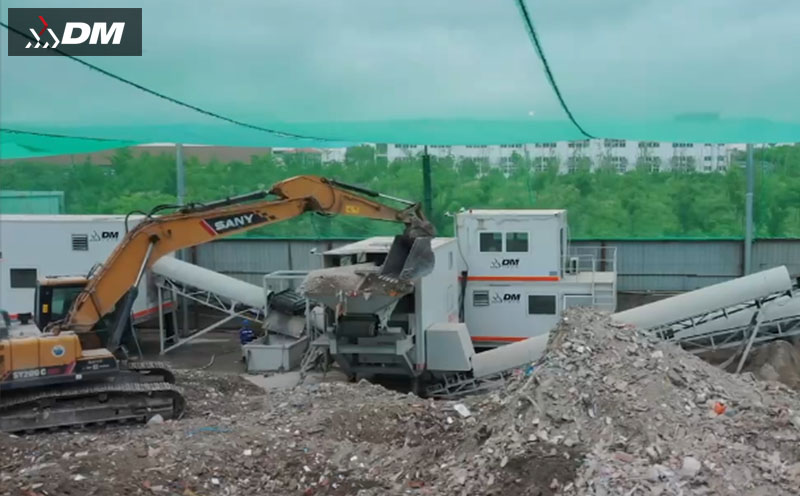
Ireland’s construction and infrastructure sectors are experiencing steady growth, but this progress comes with a pressing challenge: mounting site waste. Each year, the country generates over 1.2 million tons of construction and demolition (C&D) waste—including concrete, asphalt, bricks, and steel reinforcement—alongside substantial quarry by-products and municipal construction debris. Traditionally, most of this waste was sent to landfills, consuming valuable land resources, posing environmental risks (such as soil and groundwater contamination), and wasting the inherent value of recyclable materials. As Ireland embraces circular economy principles and tightens environmental regulations (aligned with EU Waste Framework Directive), the demand for efficient, reliable waste-to-resource solutions has never been higher. DongMeng, a global pioneer in waste recycling technology, has brought tailored recycling systems to Ireland—turning site waste into high-quality, EU-standard aggregates, supporting sustainable construction, and driving the country’s transition to a circular economy.
Integrated Recycling Process: Turning Waste into Uniform Aggregates
DongMeng’s recycling technology stands out for its integrated, multi-stage process that ensures site waste is transformed into consistent, high-performance aggregates meeting Ireland’s EN 13242 standards. The system is designed to handle diverse waste streams, from bulky concrete slabs and asphalt chunks to mixed C&D debris, delivering graded products suitable for road bases, concrete mixing, and building foundations.
The process begins with pre-screening and sorting: Waste is fed into a vibrating feeder with a preliminary screen that removes fine soil and dust (reducing contamination in the final product). Magnetic separators and optical sorters then extract steel reinforcement, plastic, and wood—key contaminants that could compromise aggregate quality. Next, primary crushing is performed by a heavy-duty jaw crusher, which breaks down large waste pieces (up to 1000mm) into manageable fragments (≤150mm). For harder materials like reinforced concrete, a secondary hydraulic cone crusher refines the particles, using laminated crushing technology to achieve a cubical shape (elongation index ≤12%). The final stage involves multi-layer high-frequency vibrating screens (1800-2200r/min) that separate the crushed material into precise grades: 0-6mm (fine aggregate), 6-10mm (medium aggregate), 10-20mm, and 20-40mm (coarse aggregate). An online particle size analyzer continuously monitors product quality, feeding data back to the centralized control system for real-time adjustments.
The result is a resource recovery rate exceeding 98%—meaning nearly all input waste is converted into usable aggregates. A single DongMeng recycling plant can process 80-300 tons of C&D waste per hour, with the final products meeting Ireland’s strict quality requirements for strength, durability, and impurity content (≤1% organic matter, ≤0.5% chloride). In a recent project in County Dublin, a DongMeng system processed 50,000 tons of demolition waste from an old industrial site, producing 49,000 tons of quality aggregates—enough to build 15km of urban road base or 200 residential buildings.
Flexible System Configurations: Adapt to Ireland's Diverse Sites
Ireland’s waste generation scenarios are highly diverse: from large-scale demolition projects in urban centers (e.g., Dublin, Cork) to small quarry by-product piles in rural areas, and road construction debris scattered across remote regions. DongMeng’s recycling systems offer flexible configurations—mobile, semi-mobile, and fixed—to adapt to these varied needs, ensuring efficient waste processing wherever it is generated.
Mobile recycling units, mounted on tracked chassis, are ideal for remote or temporary sites. Equipped with low-ground-pressure rubber tracks (≤0.17MPa), they can navigate soft soil, uneven terrain, and narrow access roads common in rural Ireland. With setup time as short as 2-3 hours, they can process waste on-site, eliminating the need for costly transportation of bulky debris to centralized facilities. For example, a tracked mobile recycling unit deployed to a road widening project in County Galway processed 12,000 tons of asphalt waste in 6 weeks, producing recycled aggregates that were immediately reused in the project’s road base—cutting material costs by 40%.
Semi-mobile systems are designed for medium-scale operations, such as quarry by-product recycling, where waste generation is consistent but site conditions may change. They balance mobility (easily relocated with flatbed trucks) and capacity (150-300 tons/hour), making them popular among Irish quarry operators. Fixed recycling plants, meanwhile, are installed in permanent locations near urban centers or major construction hubs, handling large volumes of C&D waste (up to 1.5 million tons annually). These fixed facilities integrate advanced automation and larger processing modules, optimizing efficiency for high-throughput operations.
All configurations feature modular design, allowing operators to add or remove components (e.g., additional sorters, tertiary crushers) based on waste type and product requirements. This flexibility ensures DongMeng’s systems can adapt to everything from clean concrete waste to mixed C&D debris, maximizing utility for Irish contractors, quarries, and waste management companies.
Environmental Excellence: Reduce Footprint vs. Traditional Practices
Compared to traditional waste disposal (landfilling) and virgin aggregate mining, DongMeng’s recycling technology delivers significant environmental benefits, aligning with Ireland’s climate and sustainability goals—including a 51% reduction in greenhouse gas emissions by 2030 and a circular economy target of recycling 70% of C&D waste by 2035.
Carbon emissions are drastically reduced: Producing recycled aggregates via DongMeng’s system generates just 30% of the carbon emissions associated with mining and processing virgin stone. This is achieved through multiple means: on-site processing eliminates truck trips for waste transport (cutting diesel consumption by up to 60%), energy-efficient motors and variable-frequency drives reduce power use by 18-25% compared to conventional recycling equipment, and the optimized crushing sequence minimizes energy waste. For every 100,000 tons of waste processed, DongMeng’s system saves approximately 3,000 tons of CO₂—equivalent to planting 75,000 trees.
Dust and noise pollution are also minimized to a fraction of traditional practices: Fully enclosed processing chambers, sealed conveyor belts, and high-efficiency pulse dust collectors (dust removal efficiency ≥99.9%) reduce dust emissions to just 25% of the levels from conventional crushing operations. Noise is controlled via sound insulation enclosures, vibration-damping mounts, and low-noise hydraulic systems, lowering operational noise to 65% of traditional equipment—ensuring compliance with Ireland’s noise limit of ≤75dB(A) at 10 meters and minimizing impact on nearby communities and wildlife.
Water conservation is another key advantage: Closed-loop water circulation systems recycle 95% of water used for dust suppression and equipment cooling, reducing freshwater consumption to only 5% of that required by traditional aggregate production. This is particularly valuable in Ireland’s water-sensitive regions, supporting the country’s efforts to protect groundwater resources. Additionally, by diverting waste from landfills, DongMeng’s systems extend the lifespan of disposal sites, reduce soil and groundwater contamination, and preserve natural stone reserves—contributing to long-term ecological sustainability.
Economic & Practical Value: Drive Sustainable Growth for Ireland
Beyond environmental benefits, DongMeng’s recycling technology delivers tangible economic value for Irish businesses and the broader economy, making sustainability a profitable choice.
For contractors and construction companies, using recycled aggregates cuts material costs by 25-40% compared to virgin aggregates—significant savings in large-scale projects. On-site processing eliminates waste haulage fees, which can account for 30-50% of total waste management costs. In County Limerick, a housing development project using DongMeng’s mobile recycling system saved €180,000 in material and haulage costs over 12 months. For quarries, recycling technology turns by-products (e.g., fine stone dust, low-grade rock) into revenue-generating aggregates, expanding product lines without additional mining investments.
The technology also supports Ireland’s circular economy by creating local jobs in waste collection, processing, and aggregate distribution. DongMeng’s systems are designed for easy operation and maintenance, with user-friendly control panels, centralized lubrication points, and durable components (e.g., high-chromium alloy wear parts with a 35% longer service life than standard parts) that reduce downtime and maintenance costs. Local technical support and training ensure Irish operators can maximize system efficiency, further enhancing the economic return.
From an industry perspective, DongMeng’s recycling technology helps Ireland reduce reliance on imported aggregates (which account for 15% of national demand) and strengthens domestic supply chains—critical for resilience in a global market. By turning site waste into a valuable resource, the technology transforms a financial and environmental liability into an asset, driving sustainable, inclusive growth for Ireland’s construction and waste management sectors.
As Ireland moves toward a more circular, sustainable future, DongMeng’s recycling technology is playing a pivotal role in turning the vision of “waste as a resource” into reality. From urban demolition sites to rural quarries, these systems are transforming site waste into high-quality aggregates, reducing environmental impact, cutting costs, and supporting the country’s climate and circular economy goals. With flexible configurations to adapt to diverse sites, strict adherence to Irish and EU quality standards, and a focus on both environmental and economic value, DongMeng’s recycling tech is not just a solution for waste management—it’s a driver of sustainable growth. As Ireland continues to invest in infrastructure and prioritize circularity, DongMeng remains committed to innovating its recycling systems, integrating AI-based sorting, renewable energy integration, and advanced material recovery to deliver even greater efficiency and sustainability. Together, DongMeng and Ireland are proving that construction waste can be a cornerstone of a greener, more prosperous future.
If you would like to get help immediately, you can also fill your requirements on the following form, we will contact you on the right time.


Get In Touch